
What Is Artificial Intelligence? A Complete Guide for Businesses
Table of Contents
ToggleArtificial Intelligence refers to simulation of human intellectual processes by computer systems and digital machines. These processes comprise of learning, reasoning, problem-solving, perception and language understanding. For enterprises, AI automates complex functions, improves decision-making and offers hyper-personalised experiences to customers.
Introduction
What is artificial intelligence and why is it transforming the modern global economy faster than any previous technological revolution?
Across industries, businesses are under extreme pressure to streamline their workflow, reduce overheads and extract actionable insights from oceans of data. Manual data processing and traditional software models are unable to meet the increased demand and create serious strains on customer acquisition and engagement
Understanding what is artificial intelligence along with concepts such as artificial intelligence implementations, types of AI technology and applications of artificial intelligence for businesses is the ultimate solution. This in-depth guide examines how intelligent systems work, looks at the types of AI technology, analyses the core benefits of AI in business, evaluates machine learning vs artificial intelligence, looks at examples of AI in daily life and peers into the future of artificial intelligence. Readers will learn how to harness these groundbreaking frameworks for business growth.
Table of Contents
Introduction
Defining Artificial Intelligence: Core Concepts
Types of AI Technology
Artificial Intelligence for Businesses: Strategic Value
Machine Learning vs Artificial Intelligence: Key Differences
Benefits of AI in Business
Examples of AI in Daily Life
Future of Artificial Intelligence
Step-by-Step Implementation Guide
Expert Tips for Adoption
Common Mistakes to Avoid
Frequently Asked Questions
Final Summary & Strong CTA
—
Main Content
Defining Artificial Intelligence: Core Concepts
What is artificial intelligence at its foundational engineering level?
At its core, artificial intelligence represents a branch of computer science that focuses on building smart machines capable of executing tasks that typically require human cognitive functions. These systems process structured and unstructured inputs using complex algorithms, probabilistic models, and neural network architectures to mimic human reasoning.
Example: Customer service chatbots utilize natural language processing to comprehend user sentiment and provide instant resolutions without human intervention.
Key Takeaway: Artificial intelligence acts as the bridge between raw computational power and human-like intelligence.
—
Types of AI Technology
What are the primary classifications of intelligent systems that are used in the modern technological ecosystem?
Artificial intelligence technologies are generally classified based on their capabilities (Narrow AI, General AI, Super AI) and their functional mechanics (Reactive Machines, Limited Memory, Theory of Mind, Self-Awareness). Narrow AI dominates the modern commercial applications as it is designed to execute specific duties like image recognition or predictive text.
Example: Recommendation engines used by streaming platforms use Narrow AI models to analyze viewing history and suggest custom media choices.
Key Takeaway: Understanding the different types of AI technology helps organizations choose the right technology architecture for their workflows.
—
Artificial Intelligence for Businesses: Strategic Value
How does artificial intelligence for businesses transform traditional competitive landscapes?
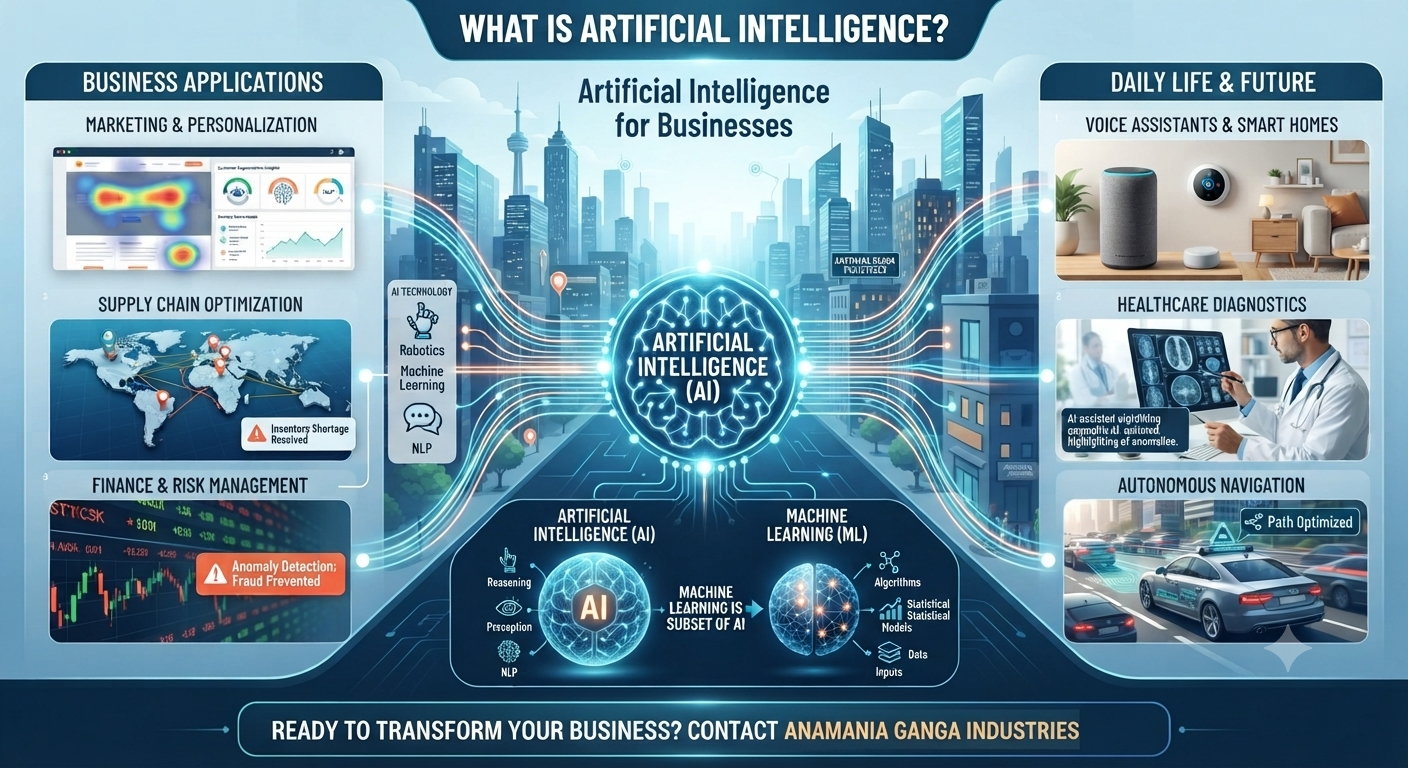
Smart automation allows enterprises to shift from a reactive to a predictive paradigm. By automating administrative tasks and analysing customer behaviour, organizations can optimize supply chains, undertake targeted marketing and speed up product innovation.
Example: Inventory management systems automatically predict shortages based on historical buying patterns and seasonal trends.
Key Takeaway: Adoption of AI for businesses unlocks unprecedented efficiency and revenue growth.
—
Machine Learning vs Artificial Intelligence: Key Differences
What is the key difference between machine learning vs artificial intelligence?
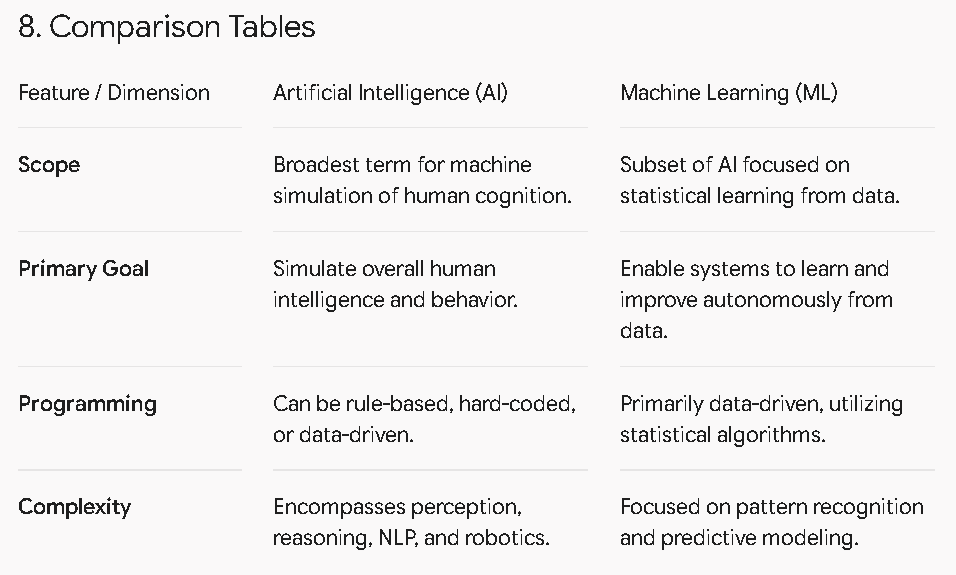
While artificial intelligence is the overarching umbrella that covers any machine simulating human intelligence, machine learning is a specialized AI field that focuses on building algorithms that learn from data. Instead of hardcoding rules, machine learning models improve their performance through continuous learning.
Example: A rule-based chess program is AI while a system that trains by playing millions of matches is machine learning.
Key Takeaway: ML is the key engine that powers modern AI applications.
—
Benefits of AI in Business
What core benefits do organizations derive from adopting intelligent automation?
Businesses gain dramatic reductions in human errors, faster decision making through automated analytics, round-the-clock customer support and reduced overheads in marketing, finance and logistics.
Example: Fraud detection models flag unauthorized credit card transactions within milliseconds.
Key Takeaway: The benefits of AI in business directly correlate with increased profits and customer retention.
—
Examples of AI in Daily Life
Where do consumers run into intelligent systems during their daily routines?
Intelligent algorithms quietly power voice assistants, navigation route optimization, spam mail filtering, facial recognition on smartphones and predictive text on mobile phones.
Example: GPS navigators recalculating fastest commute based on traffic congestion data.
Key Takeaway: AI has seamlessly integrated into consumer experiences with new expectations emerging rapidly.
—
Future of Artificial Intelligence
What technological milestones will define the future of artificial intelligence?
The coming decade will likely see substantial advancements in generative multimodal systems, quantum machine learning models, edge AI computing, and stricter regulatory frameworks around algorithmic transparency, ethics, and data privacy.
Example: Multimodal healthcare diagnostics that analyse genome data to predict hereditary diseases.
Key Takeaway: The future of artificial intelligence lies in systems that balance immense computational power with ethical governance.
—
Pros & Cons
Pros of Artificial Intelligence
High Efficiency
Eliminates repetitive manual labor and human error
Data-Processing Speed
Analyzes petabytes of structured and unstructured data in seconds
Continuous Availability
Operates 24/7 without performance degradation
Personalization
Hyper-tailored user experiences at scale
Cons of Artificial Intelligence
High Initial Investment
Requires significant capital
Data Privacy Risks
Processes vast quantities of user data
Algorithmic Bias
Can develop biases in predictions
Job Displacement Risk
Automates traditional administrative functions
—
Step-by-Step Process: Implementing AI
1. Audit Business Processes: Identify repetitive workflows, data bottlenecks, and areas where automation yields high ROI.
2. Define Clear Objectives: Establish measurable KPIs such as reducing customer ticket resolution time by 30%.
3. Data Readiness Assessment: Cleanse, organize and secure internal company data.
4. Select Suitable Technology Vendors: Choose appropriate AI tools, cloud platforms or ML frameworks.
5. Pilot Testing: Evaluate solution accuracy, latency and adoption.
6. Scale and Monitor: Monitor model drift and compliance.
—
Expert Tips
Start Small: Begin with low-risk pilot projects like customer service chatbots.
Prioritize Data Quality: Garbage in equals garbage out.
Maintain Human Oversight: Keep humans in the loop for complex decisions.
Focus on Scalability: Use cloud infrastructure that scales with business growth.
—
Common Mistakes to Avoid
Treating AI as a Magic Wand: Expecting instant profitability without clear strategy.
Ignoring Data Privacy Compliance: Failing to adhere to GDPR or local data protection laws.
Neglecting Employee Training: Implementing complex tools without upskilling teams.
Overlooking Algorithmic Bias: Deploying models without auditing training datasets.
—
Frequently Asked Questions
Q1: What is artificial intelligence in simple terms?
A: Artificial intelligence refers to computer systems engineered to perform tasks that require human intellect, such as learning, reasoning, and problem-solving.
Q2: How does artificial intelligence differ from machine learning?
A: AI is the science of mimicking human intelligence, while ML is a subset focused on learning algorithms that improve autonomously.
Q3: What are the main types of AI technology?
A: Primary classifications include Narrow AI (task-specific), General AI (human-level cognition), and Super AI.
Q4: Why is artificial intelligence important for businesses?
A: It automates repetitive tasks, enhances analytics, reduces overheads and elevates personalization.
Q5: Can small businesses afford AI tools?
A: Yes, as SaaS platforms offer scalable pay-as-you-go pricing.
Q6: Does AI replace human workers completely?
A: No, as it automates administrative tasks while enabling strategic creativity.
Q7: What industries benefit most from AI?
A: Healthcare, finance, retail, manufacturing, logistics and digital marketing.
Q8: What are the main security risks of AI?
A: Data privacy vulnerabilities and prompt injection attacks.
Q9: How do I start implementing AI in my company?
A: Begin by cleaning data, auditing operations and launching a pilot project.
Q10: What is the future outlook of AI?
A: The future points towards multimodal systems and ethical governance.
—
Final Summary
Understanding what is AI, examining the different types of AI technology and leveraging AI for businesses are critical steps for enterprise success. By mastering the difference in machine learning vs artificial intelligence, assessing the benefits of AI in business and analysing examples of AI in daily life, organizations can unlock their potential. Preparing for the future of artificial intelligence will position them for competitive advantage.
—
Ready to accelerate your business growth or upgrade your style?
At Anamania Ganga Industries, we combine cutting-edge technology solutions with top-tier digital insights. But we don’t just stop at tech—explore our exclusive, trend-setting clothing collection on our e-commerce platform to find your next favorite outfit.
👉 [Click Here to Visit Our E-Commerce Store & Explore Latest Clothing Collection]
IF YOU WANT READ MORE LIKE EXPLORE MORE VISIT OUR BLOG PAGE..