Table of Contents
ToggleCONTENT MARKETING
Content Marketing in 2026: AI Overview Optimization, Marketing Videos, Zero-Click Content & The Future of Content
Content Marketing in 2026: AI Overview Optimization, Marketing Videos, Zero-Click Content & The Future of Content
Introduction to Modern Content Marketing
Why Content Still Rules the Digital World
Let’s be honest — content is everywhere. From marketing videos scrolling on your feed to every social media content update you tap on, content marketing is no longer optional. It is survival.
In the first few seconds of landing on a page, people decide: stay or leave? That’s the emotional battlefield where content wins or loses. Today, content is not just about writing blogs. It includes marketing videos, shoppable video marketing, conversational search intent, AI Overview Optimization, and even the small but powerful vedo marketing post that quietly grabs attention.
The world has shifted. Search engines now think. AI tools summarize. Users don’t always click. So how do you win? You evolve.
The Emotional Power Behind Content
Great content doesn’t just inform. It connects. It makes someone feel seen. Think of content like a bridge — it connects a brand’s voice to a human heart.
And in 2026, that bridge is built with AI, data, storytelling, and trust.
AI Overview Optimization and the Rise of AEO (Answer Engine Optimization)
What is AI Overview Optimization?
AI Overview Optimization is about crafting content that AI systems can easily understand, summarize, and feature in search results. Instead of only ranking for blue links, your content now needs to appear inside AI-generated summaries.
If your content is structured clearly, answers real questions, and delivers Information Gain, AI platforms reward you with visibility.
AEO vs Traditional SEO
AEO (Answer Engine Optimization) goes beyond ranking. It focuses on answering.
Traditional SEO was about keywords. AEO is about solutions. It understands conversational search intent. When someone asks, “What is the future of content marketing?” your article should answer directly — naturally and confidently.
Optimizing for Conversational Search Intent
People search like they speak. “How do I grow with marketing videos?” “Why is Zero-Click Content important?”
Your content should mirror this tone. Keep it simple. Direct. Human.
Information Gain and Zero-Click Content
What is Information Gain?
Information Gain means offering something new. Not recycled ideas. Not generic advice. Unique insights.
Search engines prioritize pages that add fresh value. Ask yourself: Does this paragraph teach something new? If not, rewrite it.
Winning the Zero-Click Content Game
Zero-Click Content is rising fast. Users get answers directly from search results without visiting websites.
Sounds scary? It’s not.
If your content fuels those answers, your brand becomes the source. Visibility becomes credibility. Structure your content with clear headings, concise answers, and entity-based SEO principles to win this space.
Marketing Videos and Shoppable Video Marketing
Why Marketing Videos Convert Faster
Let’s be real — people love watching more than reading. Marketing videos spark emotion instantly. A smile. A surprise. A tear.
Video marketing post strategies work because they reduce friction. Instead of explaining for five paragraphs, show it in thirty seconds.
The Growth of Shoppable Video Marketing
Shoppable video marketing removes the gap between inspiration and action. Watch. Click. Buy.
It feels seamless. It feels natural. It’s powerful content marketing in motion.
Micro-Dramas for Brands
Micro-dramas for brands are short emotional stories. Thirty seconds of connection. A relatable problem. A satisfying solution.
They create memory. And memory builds loyalty.
Founder-Led Content Strategy and E-E-A-T Ranking Signals
Why Founder Stories Build Trust
Founder-led content strategy is exploding. Why? Because people trust people.
When founders share experiences, lessons, and failures, they activate E-E-A-T ranking signals — Experience, Expertise, Authoritativeness, and Trust.
Authenticity isn’t optional anymore. It’s currency.
Understanding E-E-A-T Ranking Signals
Search engines reward credibility. Showcase real experiences. Use human-verified content. Share case studies. Add depth.
Trust wins rankings.
Entity-Based SEO and Semantic Content Mapping
Moving Beyond Keywords
Entity-Based SEO focuses on meaning, not just keywords. It connects topics, relationships, and context.
Instead of repeating “content” endlessly, build semantic content mapping. Connect related ideas like AI Agentic Workflows, social media content, and content optimizing under a unified strategy.
Building Authority Through Entity-Based SEO
When search engines understand your expertise across connected topics, authority grows naturally.
Think of it like building a web. Every related topic strengthens your position.
AI Agentic Workflows and Human-Verified Content
AI Agentic Workflows Explained
AI Agentic Workflows automate planning, research, drafting, and optimization. They save time. They increase scale.
But scale without soul? Dangerous.
Why Human-Verified Content Matters
Human-verified content ensures accuracy, emotional intelligence, and clarity. AI can assist. Humans must refine.
The future of content marketing is not AI vs humans. It’s AI with humans.
Social Media Content and Vedo Marketing Post Trends
Creating Engaging Social Media Content
Social media content should spark conversation. Ask questions. Share quick wins. Post marketing videos. Share a vedo marketing post that hooks attention.
Attention is fragile. Earn it respectfully.
The Emotional Power of a Vedo Marketing Post
A vedo marketing post can combine short video storytelling with sharp captions. It feels personal. Fast. Relatable.
And when done right, it spreads organically.
Content Optimizing for Long-Term Growth
Smart Content Optimizing Techniques
Content optimizing means updating old blogs, refining structure, improving clarity, and aligning with AI Overview Optimization principles.
It’s not about producing more. It’s about improving better.
Balancing AI and Human Creativity
Think of AI as a powerful engine. But humans? We are the driver.
We decide the direction. The emotion. The impact.
That balance creates sustainable growth.
Conclusion
Content marketing in 2026 is not about noise. It’s about meaning.
It blends AI Overview Optimization, AEO, Entity-Based SEO, marketing videos, shoppable video marketing, and founder-led content strategy into one cohesive system.
The future belongs to brands that understand conversational search intent, deliver Information Gain, and create human-verified content that truly connects.
Because at the end of the day, content is not code. It’s conversation.
And conversations change everything.
Content marketing is an excellent strategy to make potential customers aware of your brand.
The ‘content’ in content marketing could be a video, blog post, podcast, or social media post.
As most potential customers often do some preliminary research before purchasing products or services, they’ll likely find your content before making a purchase decision.
If your content is helpful, those potential customers are more likely to trust your brand and buy your products or services when they’re ready to make a purchase.
The problem is that not all content marketing strategies are equally effective.
You need to know what problems your potential customers are searching, what makes a piece of content convert, which content platforms they’re using, and how to work with platform algorithms to get in front of your potential customers.
OVERVIEW
- Purpose: To build long-term relationships, boost SEO, increase brand awareness, and generate leads.
- Content Types: Articles, blogs, videos, podcasts, infographics, white papers, ebooks, and webinars.
- Strategy:Successful content marketing requires a documented, customer-centric approach that aligns with the customer’s buying journey.
- Key Principles: The 5 C’s—Clarity, Consistency, Creativity, Customer-Centricity, and Conversion-Focused.
- Enhanced SEO: High-quality content improves search rankings, as websites with active blogs have significantly more indexed pages.
- Brand Authority: Consistently delivering useful information establishes credibility and trustworthiness.
- Lead Generation: Content marketing can drive more leads compared to traditional, direct-selling approaches.
- Customer Engagement: It builds stronger relationships by providing value, making it more likely that customers will choose your brand when ready to purchase.
- Blog Posts: The foundation for driving traffic and SEO.
- Social Media: Used to reach audiences on platforms like LinkedIn, TikTok, and Instagram.
- Video Marketing: YouTube and short-form videos to educate or entertain.
- Educational Content: How-to guides, infographics, and webinars that solve audience problems.
The 7 steps of content marketing typically involve defining goals, understanding your audience (personas), researching topics & keywords, creating valuable content, distributing across channels, engaging with your community, and measuring performance to refine your strategy, with key phases being planning, production, and analysis. This cycle focuses on attracting and retaining an audience by consistently providing helpful, relevant content that aligns with business objectives.
- Define Goals & Strategy:
Set SMART (Specific, Measurable, Achievable, Relevant, Time-bound) objectives, like increasing leads or brand awareness, and align them with your business mission.
Create detailed buyer personas based on demographics, pain points, and motivations to tailor content effectively.
Identify content topics and keywords through research, then map them to the buyer’s journey using a content calendar.
Produce valuable, consistent content (blogs, videos, etc.) that addresses your audience’s needs.
Share your content across relevant channels like social media, email, and SEO to reach your audience.
Interact with your audience, answer questions, and foster a loyal community around your brand.
Track key metrics (traffic, conversions) to see what works and continuously improve your content’s effectiveness.
some 5 C’s of content marketing
The 5 Cs of content marketing offer different frameworks, but generally focus on key principles for effective content: Customer-Centricity, Clarity, Consistency, Creativity/Compelling, and Conversion-focused/Call to Action. Other versions emphasize Content Creation, Curation, Consistency, Collaboration, and Calibration, or Content, Context, Community, Channels, and Conversion, all aiming to create valuable, engaging content that drives business results.
- Customer-Centricity:Content must address audience needs, pain points, and interests.
- Clarity:Messages are simple, jargon-free, and easy to understand.
- Consistency:Regular publishing builds trust and loyalty.
- Compelling/Creativity:Content is unique, engaging, and differentiates the brand.
- Call to Action (CTA)/Conversion:Guides the audience to the next desired step (e.g., purchase, sign-up).
Framework 2: Process-Oriented
- Content Creation:Producing valuable content.
- Content Curation:Sourcing and sharing relevant third-party content.
- Content Consistency:Maintaining a regular schedule.
- Content Collaboration:Partnering with others to expand reach.
- Content Calibration:Analyzing performance and adjusting the strategy.
Framework 3: Foundational Principles
- Content:The actual material (blogs, videos, etc.).
- Context:The relevance and environment of the content.
- Community:Building loyalty through engagement.
- Channels:Effective distribution across platforms.
- Conversion:Driving desired actions.
How Does Content Marketing Work?
Effective content marketing attracts people to your brand.
You might publish a video, podcast episode, or blog post, and then people interested in the topic consume it and become acquainted with your brand voice.
Once you have that person’s attention, you can build a trusting relationship with them. As a result, you can sell them products and services.
4 Ways Content Marketing Can Help Your Business
Companies with excellent content marketing strategies have an unfair advantage over their competitors for several reasons. Below we’ll discuss just a few of them.
1. Reduce Customer Acquisition Costs
Quality content creation isn’t cheap, but you’ll see a stronger ROI from each piece of content you produce because your audience will grow.
It’s a snowball effect.
The first video, blog post, or social media post you publish might only be seen by a few people, but as more and more people find your content and become followers, each sequential piece of content you publish will be seen by more people and produce a stronger ROI.
So unlike paid ads, where you and your competitors can earn roughly the same ROI for each dollar spent, brands with strong content marketing strategies and a large audience can earn significantly more for each piece of content published.
2. Improve Lead Quality
Another benefit of content marketing is that you can filter the type of customers you attract based on the content you produce.
For example, if your target audience is exclusively CMOs, you can discuss only topics that a CMO would be interested in, like hiring great talent. You might also offer access to exclusive reports on industry benchmarks that would interest a CMO.
In contrast, paid ads force you to rely on the platforms to accurately identify your target audience. With privacy concerns on the rise and less accurate audience targeting, these platforms are producing lower returns.
3. Build a Stable Lead Pipeline
Content marketing has a flywheel effect and produces higher returns over time – especially if you produce evergreen content.
With evergreen content (content that is relevant for years), you can continue to generate returns from it even years after it was published.
So even if you stop producing content for a period of time, you’ll still likely have a steady pipeline of leads thanks to your evergreen content.
4. Increase Customer Retention and Loyalty
Content marketing is essentially a cheat code to build trust with your potential customers at scale.
The more they become familiar with your brand’s viewpoints and identity, the easier it is to trust your brand and the more likely they are to continue purchasing from your brand.
Forms of Content Marketing
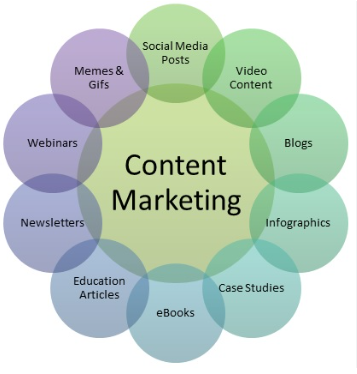
Content marketing can be any type of media across a variety of platforms, though the most common forms of content marketing include:
- Long-form text (Blog posts, white papers, case studies, etc.)
- Social media posts
- Video content
- Podcasts
- Emails
Below we’ll discuss each of these types of content in detail and when you should use them.
Long Form Written Content (Blogs, White Papers, Research, etc.)
Blog posts are the bread and butter of the content marketing strategy for most B2B and even many B2C companies and local businesses. Blogging is valuable because it can help you rank in search engines for keywords that your ideal customers may search.
For example, if you sell CRO software, ranking first in Google for the term “best CRO software” will help you drive valuable leads because those searchers are clearly looking to purchase a product like yours.
The process of optimizing blog posts to rank at the top of Google is called SEO (search engine optimization).
While blog posts are excellent at generating organic traffic to your website, effective marketers know that they need to also provide a next step to move the visitor through the buyer journey and eventually convert them into a customer.
Therefore, savvy content marketers often include a call to action in the blog posts to download a lead magnet, like a white paper or research study, in exchange for their email address.
Once you have a website visitor’s email address, you can retarget them with other valuable content to move them through your marketing funnel.
Another major benefit of long-form content like blog posts is that they often produce compounding results (assuming the content is evergreen or updated every few years).
Video Content
Video content is also becoming increasingly common in B2B and B2C content marketing strategies, as it’s now easier than ever to record a high-quality video on even a simple iPhone.
It’s also easier to quickly build a relationship with your audience if they can see and hear you, which is likely because body language makes it easier to trust a person.
Video content is also excellent for content repurposing, as you can turn a single video into podcast episodes, social media clips, emails, or blog posts.
The downside with video content is that the best video content usually features a person, so it might not be a great option if there isn’t anyone within the company who enjoys being on camera. In addition, the person on camera will likely become the face of the brand. If that person later leaves the company, the audience might leave as well.
Podcasts
There are more podcast listeners (and podcasters) than ever before. But even with the competition, starting a podcast is an effective way to grow your audience.
When people hear your voice and stories repeatedly, it’s easy to quickly build a deeply loyal following. Podcasts also have very high retention as, unlike other forms of content marketing, the audience can passively consume your content. So, unlike videos or blog posts that require the listener’s undivided attention, they might multitask while listening to your podcast.
Your podcast will also likely become part of that person’s routine, which makes the audience even stickier. For example, they might always listen to your podcast while driving to work or working out at the gym.
Like video content, the downside of podcast content is that you’ll likely lose your audience if the podcast host decides to leave your company.
Content Marketing Strategy: Ek Simple 5-Step Blueprint
Aaj ke digital era mein sirf content banana kaafi nahi hai; ek solid strategy ka hona zaroori hai. Copyblogger ke mutabik, agar aap bina planning ke content publish kar rahe hain, toh aap apna waqt aur ROI (Return on Investment) dono barbaad kar rahe hain. Niche diye gaye 5 steps aapko ek impactful strategy banane mein madad karenge:
Step 1: Apne Ideal Target Customer ko Define Karein
Content tabhi kaam karta hai jab wo sahi insaan tak pahunche. Agar aap sabko khush karne ki koshish karenge, toh kisi ko bhi convert nahi kar payenge.
AI Insight: Apne customer ka ek “Buyer Persona” banayein. Unka job title, pain points (takleefein), aur wo kis level ki jankari search kar rahe hain, ye sab clear hona chahiye.
Step 2: Marketing Funnel Map Karein aur Formats Chunein
Har customer turant kharidne ke mood mein nahi hota. Aapko unhe ek raste (funnel) se guzarna hoga:
Awareness: Blog posts ya social media ke zariye unhe problem ke baare mein batayein.
Consideration: Comparison videos ya case studies se dikhayein ki aapka solution best hai.
Decision: Webinars ya free trials se unhe purchase karne ke liye convince karein.
Step 3: Apne Content Goals aur Unique Point of View (POV) Set Karein
Internet par har topic par content maujood hai. Log aapko kyu padhein? Aapka viewpoint alag hona chahiye.
Apne goals clear rakhein (Jaise: Traffic badhana, Leads generate karna, ya Brand authority banana).
Apne experience aur unique style ko content mein daalein taaki wo “Generic” na lage.
Step 4: Content Calendar aur Workflow Banayein
Consistency (nirantarta) hi content marketing ki jaan hai. Agar aap kabhi-kabhi post karenge, toh audience aapko bhool jayegi.
AI Tool Tip: Trello, Asana ya Notion jaise tools ka use karke ek editorial calendar banayein. Har post ki deadline aur responsibility fix karein taaki process automate aur disciplined rahe.
Step 5: Results ko Test aur Measure Karein
Strategy banane ke baad ye dekhna zaroori hai ki kya kaam kar raha hai aur kya nahi.
Google Analytics ya social media insights ka use karein.
Sirf ‘Likes’ na dekhein; ye dekhein ki kya traffic leads mein badal raha hai aur kya purane customers wapas aa rahe hain.
Summary:
Agar aap apne content ko sirf “shauk” nahi balki ek “Growth Asset” banana chahte hain, toh ye summary aapke kaam aayegi:
Audience Identification: Sabse pehle apne Ideal Buyer Persona ko pehchanein. Unke pain points aur knowledge level ke hisaab se content design karein taaki sahi log attract hon.
Funnel Mapping: Content ko Buyer’s Journey (Awareness → Consideration → Decision) ke hisaab se baantein. Har stage ke liye alag format (Blogs, Videos, Case Studies) ka use karein.
Unique POV (Point of View): Sirf information mat dein, apni Expertise aur Authority dikhayein. Generic content ke bheed mein apna ek alag nazariya (Opinion) pesh karein.
Consistency & Workflow: Ek Editorial Calendar banayein. Trello ya Asana jaise tools ka use karke publishing process ko disciplined rakhein taaki audience aapko bhool na jaye.
Data Tracking: Content dalne ke baad Metrics (Traffic, Leads, Brand Awareness) check karein. Jo kaam kar raha hai usse aur zyada karein aur jo nahi, usse badal dein.
Bottom Line: Content marketing ek snowball effect hai. Agar aap sahi audience ke liye consistent aur valuable content banate hain, toh ye waqt ke saath aapki Customer Acquisition Cost (CAC) ko kam karta hai aur Trust build karta hai.
Content Marketing Tips
In 2026, content marketing has shifted from “volume” to “value and visibility.” Because AI (like Gemini and ChatGPT) can now summarize the web in seconds, standard “tips” are no longer enough. You need to focus on Information Gain and AI-Citatability.
Here are 5 advanced content marketing tips for 2026, rewritten with a human-AI collaborative touch:
1. Optimize for GEO (Generative Engine Optimization)
Ranking on Page 1 of Google is no longer the only goal; you now want to be the cited source in AI-generated answers.
The Tip: Use “Scrape-able” structures. Start your sections with clear, direct definitions (e.g., “Content Orchestration is…”) and use bulleted lists for key takeaways. This makes it easy for AI models to pull your brand into their summary as the authoritative answer.
2. Focus on “Information Gain”
Google and AI engines now prioritize content that adds new value rather than just rephrasing what’s already out there.
The Tip: If you are writing about a common topic, include primary data (surveys you ran), unique case studies, or contrarian opinions. If your content looks exactly like the top 10 results, AI will ignore you. Be the “signal” in a world of AI “noise.”
3. Mastering “Zero-Click” Content
Platforms (LinkedIn, X, Google) are trying harder than ever to keep users on their own sites.
The Tip: Don’t just post a link and say “Read more.” Give the entire value away in the post itself (the “Zero-Click” method). When you provide value upfront without forcing a click, you build massive brand trust, which eventually leads to higher-quality conversions when the user does finally visit your site.
4. Move from Production to “Orchestration”
Don’t just hit “Publish” and move on. In 2026, a single piece of content should be the “parent” of an entire ecosystem.
The Tip: Use Agentic Workflows. Use AI agents to automatically take one high-quality webinar or long-form article and “orchestrate” it into 10 LinkedIn threads, 5 YouTube Shorts scripts, and a personalized email segment. The human handles the “Soul” (strategy); the AI handles the “Scaffolding” (distribution).
5. Build “Value-Proof” Narratives
Buyers in 2026 are “info-vores”—they finish 80% of the buying process before ever talking to a human.
The Tip: Be radically transparent. Write about your pricing, your flaws, and how you compare to your biggest competitors. By answering the “uncomfortable” questions that others avoid, you become the only trusted advisor in your space.
Forget the dry, robotic marketing fluff. In 2026, if your content feels like a textbook, it’s getting skipped. Here is the strategy reinvented for the Gen Z era:
1. Stop “Researching” and Start Lurking
Don’t just look at a dashboard; get in the trenches. If your audience is on Discord, Reddit, or private Slack channels, you need to be there too. Don’t just “analyze” them—vibe with them. Listen to their actual rants and unfiltered struggles. That’s where the real content gold is buried, not in some boring keyword tool.
2. The “Soft Launch” Pitch
Hard selling is an instant “ick.” Gen Z smells a sales pitch from a mile away. The move is Contextual Selling. Educate the hell out of your audience first. Give them the blueprint for free. When you finally mention your product, it shouldn’t feel like an ad—it should feel like the obvious “cheat code” to solve the problem you just helped them identify.
3. High “Information Gain” or It’s Mid
AI can yap all day about general topics. If your post is just a remix of the top 10 Google results, it’s “mid” (mediocre). To actually rank and get noticed, you need Information Gain. Give us a hot take, a personal fail, or original data. If you aren’t adding something new to the conversation, you’re just adding to the noise.
4. Zero-Click Energy
Stop gatekeeping the good stuff behind “Read More” links. Give the whole value away right there on the feed. Whether it’s a LinkedIn carousel or a TikTok breakdown, provide the solution upfront. When you provide value without begging for a click, you build massive brand authority. People will eventually visit your site because they trust you, not because you tricked them with a headline.
5. Be a Main Character (Authority)
People follow people, not faceless corporations. Lean into Founder-led content and storytelling. Be transparent about your wins and your “L’s” (losses). Use a voice that sounds like a human, not a legal department. In 2026, authenticity is the only SEO strategy that actually scales.
History
Traditional marketers have long used content to disseminate information about a brand and build its reputation. Taking advantage of technological advances in transportation and communication, business owners began applying content marketing techniques in the late 19th century. Content marketing aims to attract and retain audiences by consistently creating and sharing valuable, relevant, and free content.
During the golden age of TV, between the 1940s and 1950s, advertising took over the media. Companies focused on sales rather than connecting with the public. There were few ventures into content marketing and not many prominent campaigns.
During the baby boom era, Kellogg’s began selling sugary cereal to children. With this change in business model came sociable animal mascots, lively animated commercials and the back of the cereal box as a form of targeted content marketing. This represented a new approach to making a brand memorable with the audience.
In the 1990s, everything changed for marketers. The arrival of computers and the Internet made websites and blogs flourish, and corporations found content marketing opportunities through email.
E-commerce adaptations and digital distribution became the foundation of marketing strategy.
The Internet also helped content marketing become a mainstream form of marketing. Traditional media such as newspapers, magazines, radio and TV started to lose their power in the marketplace. Companies started to promote and sell their products digitally.
The phrase “content marketing” was used as early as 1996, when John F. Oppedahl led a roundtable for journalists at the American Society for Newspaper Editors.
- In 1998, Jerrell Jimerson held the title of “director of online and content marketing” at Netscape.
- In 1999, author Jeff Cannon wrote, “In content marketing, content is created to provide consumers with the information they seek.”
By the late 2000s, when social networks such as Facebook, Twitter, and YouTube were born, online content marketing was accessible, shareable and on-demand anytime worldwide.
By 2014, Forbes Magazine’s website had written about the seven most popular ways companies use content marketing. In it, the columnist points out that by 2013, the use of content marketing had jumped across corporations from 60% a year or so before, to 93% as part of their overall marketing strategy. Despite 70% of organisations creating more content, only 21% of marketers think they are successful at tracking return on investment.
Today, content marketing has become a powerful model for marketers. Storytelling is part of it, and they must convey the companies’ messages or goal to their desired audience without pushing them to just buy the product or service.
Implications
The rise of content marketing has turned many traditional businesses into media publishing companies.
For example:
- Red Bull, which sells a high-energy beverage, has published YouTube videos, hosted experiences, and sponsored events around extreme sports and activities like mountain biking, BMX, motocross, snowboarding, skateboarding, cliff-diving, freestyle motocross, and Formula 1 racing. Red Bull Media House is a unit of Red Bull that “produces full-length feature films for cinema and downstream channels (DVD, VOD, TV).” The Red Bulletin is an international monthly magazine published by Red Bull, focusing on men’s sports, culture, and lifestyle.
- Personal finance site Mint.com used content marketing, specifically their personal finance blog MintLife, to build an audience for a product they planned to sell. According to entrepreneur Sachin Rekhi, Mint.com concentrated on building the audience for MintLife “independent of the eventual Mint.com product.” Content on the blog included how-to guides on paying for college, saving for a house, and getting out of debt. Other popular content included in-depth interviews and a series of financial disasters called “Trainwreck Tuesdays.” The popularity of the site surged as did demand for the product. “Mint grew quickly enough to sell to Intuit for $170 million after three years in business. By 2013, the tool reached 10 million users, many of whom trusted Mint to handle their sensitive banking information because of the blog’s smart, helpful content.”
The rise of content marketing has also accelerated the growth of online platforms, such as YouTube, Yelp, LinkedIn, Tumblr, Pinterest, and more.
For example:
- YouTube, a subsidiary of Google, is an online video platform driving (and benefiting from) the surge to content marketing. As of 2016, YouTube had over 1 billion users, representing 1/3 of all internet users and reaching more people 18–34 years of age than any cable provider in the U.S.
- Yelp, an online business directory, has seen 30% year over growth in the number of reviews, ending the second quarter of 2016 with 108 million reviews for over 3 million businesses.
Businesses actively curate their content on these platforms with hopes to expand their reach to new audiences.
Part of transitioning to a media publishing mindset requires a change in structure and process to create content at “the speed of culture.” Marketing content production is transforming from an advertising agency model to a newsroom model, according to one consultant.
It looks like you are building a comprehensive overview of Digital Content Marketing as a management process. The text you’ve provided highlights a crucial shift in modern business: marketing is no longer just about “telling” people about a product; it is about managing the entire digital experience to meet their needs.
Here is a structured summary of the core concepts from your research, synthesized for clarity:
1. Defining Digital Content Marketing
At its core, this is a management process. It isn’t just a single ad; it’s a strategic approach using digital products and electronic channels to:
Identify: Discover what the customer actually wants.
Forecast: Predict future trends or needs.
Satisfy: Deliver the content or product that fulfills that need.
2. Success Models: Viral Case Studies
The examples you cited show that successful digital content marketing often bypasses traditional high-cost advertising in favor of high-impact engagement:
| Campaign | Key Strategy | Impact |
| Dollar Shave Club | Low-cost, high-humor video. | 12k signups in 48 hours; 21M+ views. |
| The Big Word Project | User-generated content & crowdsourcing. | Global blogger attention; redefined a dictionary. |
| TE-A-ME (Tea Bags) | “PR Stunt” / Topical marketing. | 3.1M views in 72 hours; global media coverage. |
| Spotify Wrapped | Data-driven personalization. | Dominates social media every December; boosts app ranking. |
3. The Digital Supply Chain & UX
Digital marketing bridges the gap between commercial stakeholders (publishers) and end-users (customers).
The Intermediary’s Role: Distributors (like search engines or library databases) act as the vital link. They don’t just “host” content; they use external channels to help consumers find exactly what they are looking for.
User Experience (UX) is King: Because the interaction happens through digital products (websites, apps, videos), the success of the marketing depends entirely on how the user feels while interacting with those channels. If the “service experience level” is poor, the marketing fails.
4. Electronic Service (e-Service)
The hallmark of digital content marketing is the Interactive Network Service. Unlike traditional service, e-service offers:
Time & Space Independence: No opening hours or geographic limits.
Omni-channel Integration: It works alongside email, chat, and physical services to create a complete loop.
Direct Interaction: Customers use technology to communicate directly with the organisation, allowing for faster feedback and relationship building.
Executive Summary: Digital Content Marketing
Digital Content Marketing (DCM) is a strategic management process that leverages digital products and electronic channels to identify, forecast, and satisfy customer needs. Unlike traditional advertising, DCM focuses on the user experience (UX) within the digital supply chain.
Successful DCM is characterized by:
Viral Efficiency: High-impact, low-cost creative content (e.g., Dollar Shave Club).
Data Personalization: Using consumer data to create shareable moments (e.g., Spotify Wrapped).
Agile Distribution: Utilizing “smart agents” and search engines to bridge the gap between content providers and end-users.
Continuous Engagement: 24/7 interaction through electronic services (e-mail, chat, and interactive networks) that remove geographic and time constraints.
The “Way of Digital Content Marketing” Framework
Based on your provided research, this 4-pillar framework explains how to move from a “product” to a “successful digital experience.”
1. The Discovery Pillar (Identify & Forecast)
Action: Use “Smart Agents” and search data to understand what users are looking for.
Goal: Don’t just make content; make the specific content that satisfies a pre-identified digital search intent.
2. The Creative Spark (The “Viral” Trigger)
Action: Develop content that is either highly humorous (Dollar Shave Club), personally relevant (Spotify Wrapped), or culturally provocative (TE-A-ME).
Goal: Minimize production costs while maximizing “shareability” to achieve organic reach.
3. The Supply Chain Link (Distribution & UX)
Action: Optimize the interface between the publisher and the consumer.
Goal: Ensure the website, app, or video player is seamless. The User Experience is the delivery vehicle for the marketing message. If the tech fails, the marketing fails.
4. The E-Service Loop (Interaction)
Action: Integrate interactive network services (Email, live chat, social media).
Goal: Move beyond “one-way” broadcasting. Create a 24/7 feedback loop where the customer can interact with the brand regardless of distance or time zones.
Please don’t forget to leave a review.

Explore More Blogs
BLOG


