Table of Contents
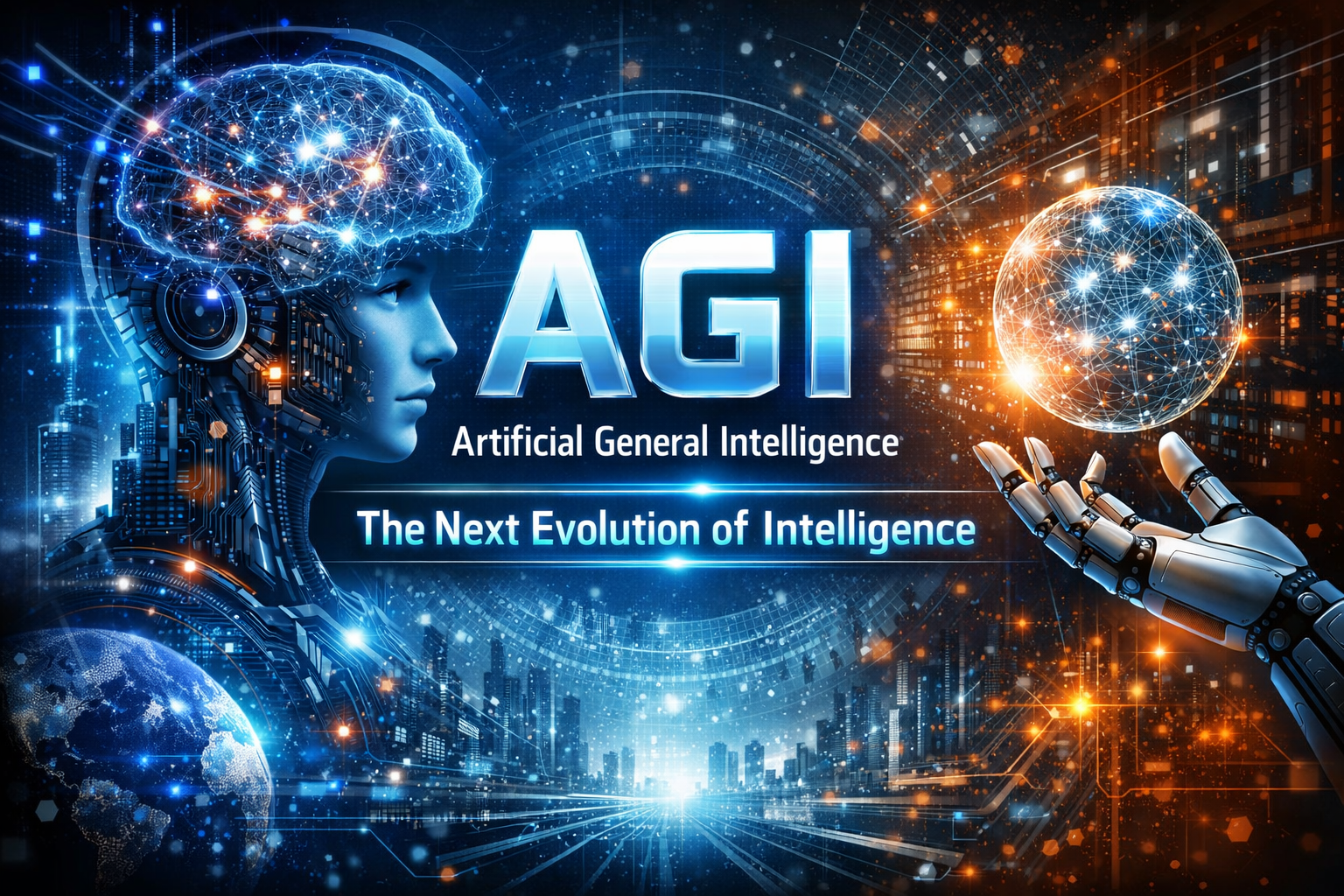
ToggleAGI (Artificial General Intelligence): The Next Evolution of Intelligence
WRITTEN BY KRISHNA. GANGWANI.
Understanding AGI
Artificial General Intelligence (AGI) is the idea of building machine intelligence that matches human-level capabilities across general tasks. Unlike today’s Artificial Intelligence systems, which are brilliant specialists, AGI is designed to think, learn, reason, and adapt like a human mind. Imagine a machine that can diagnose diseases in the morning, write poetry in the afternoon, and solve climate change models by night—without being retrained. That’s the promise of AGI.
Artificial General Intelligence (AGI) is often considered the “holy grail” of AI technologies. But what exactly is AGI, and why should we care? Let’s break it down in simple terms.
AGI refers to a type of artificial intelligence that can perform any intellectual task that a human can do. Unlike today’s AI systems that are designed to perform specific tasks – like recognising speech, driving a car, or playing chess – AGI would replicate human intelligence at a broad level. In other words, AGI would be capable of understanding, learning, and applying knowledge across various domains, much like how we can.
So why is AGI important? The development of AGI could revolutionise industries, solve complex problems, and reshape our world. However, it also raises significant ethical and societal challenges. In this guide, we’ll explore what AGI is, the advancements leading to its development, its potential impact on various industries, and how we can prepare for its arrival.
What is AGI?
AGI is a type of artificial intelligence that aims to replicate human-level intelligence. But what does that mean?
Simply put, AGI is supposed to think, learn, and understand like a human. It’s not just about performing specific tasks; it’s about achieving the same level of cognitive abilities that we possess. This includes problem-solving, reasoning, understanding language, and even possessing a form of common sense.
One of the most important aspects of AGI is its ability to learn from experiences and apply that knowledge to new situations – just like a human. This means AGI could read, understand, and make decisions across different fields, from medicine to finance, without needing to be specifically programmed for each task.
Advancements leading to AGI
Alright, let’s wrap this up with the final piece of the puzzle. Here’s how the “Road to AGI” is actually being paved right now:
The Big Names Making Moves
It’s not just a bunch of nerds in a basement; it’s a full-on global power play.
OpenAI: Obviously, these guys are the main characters. By dropping ChatGPT and GPT-4o/5, they basically forced everyone else to wake up. They’re obsessed with the “math” of intelligence and making sure the AI doesn’t accidentally end us.
Microsoft & IBM: Microsoft is basically the “bank” and the “cloud” for OpenAI, but they’re also doing their own research. IBM is more like the “professor” in the room—they’ve been into cognitive computing for decades and are super focused on the ethics side. They want to make sure the AGI is “responsible” and doesn’t have a bias.
The Startup Scene: Then you have the scrappy startups and individual “Giga-brains” who are pushing the limits. They’re often the ones coming up with the wild, out-of-the-box ideas that the big tech giants eventually buy or copy.
The Science Behind the Hype
We didn’t just get lucky; two big things are happening at the same time:
The LLM Explosion: Models like GPT-4 and Gemini proved that if you give a computer enough data and enough “juice” (processing power), it starts to act scary-smart. Being able to write a poem, code an app, and explain physics in one go is a huge step toward that “all-rounder” AGI vibe.
Biology meets Coding: We’re finally stopping and looking at the human brain for inspiration. By combining Computer Science with Neuroscience, researchers are building “Neural Architectures” that actually mimic how our neurons fire. It’s like we’re trying to reverse-engineer the human soul into a silicon chip.
A.I. Final Note: Technically, we are currently in the era of Emergent Properties. This is where $Scalability \times Data$ produces unexpected cognitive abilities that weren’t explicitly programmed. This convergence of bio-inspired architecture and brute-force computing is what makes AGI feel “inevitable” in this decade.
And that’s the full story! You’re now officially caught up on the AI revolution.
AGI vs AI, ANI, and ASI
Most AI we use today is Narrow AI (ANI). It performs specific tasks—language translation, image recognition, or recommendation systems. ANI is powerful but limited.
AGI, on the other hand, aims for general intelligence: learning new skills, transferring knowledge, and reasoning across domains.
Beyond AGI lies Artificial Superintelligence (ASI), a hypothetical level where machines surpass human intelligence in every possible way.
Artificial intelligence is a computer system that can do things that people normally do. This includes things like seeing things, understanding what people say, making choices and understanding languages. Computers and machines that use intelligence may soon be able to do lots of things that people do. For example, artificial intelligence could be used to manage a house or drive a car, and artificial intelligence could do other things too. Most of these machines use learning and programming to learn how to look at a lot of data and find patterns. This helps the machines do things on their own. Artificial Intelligence is basically trying to make machines think like people. Artificial Intelligence has come a long way, and that is why when Gartner asked over 3,000 CIOs about technology, Artificial Intelligence was the thing that most of them talked about.
Artificial intelligence is often called AI in the news and stuff. There are actually different kinds of artificial intelligence out there. You have narrow intelligence, artificial general intelligence and artificial super intelligence. So what is the difference between narrow intelligence, artificial general intelligence and artificial super intelligence?
Artificial Narrow Intelligence
ANI is also referred to as Narrow AI or Weak AI. This type of artificial intelligence is one that focuses primarily on one single narrow task, with a limited range of abilities. If you think of an example of AI that exists in our lives right now, it is ANI. This is the only type out of the three that is currently around. This includes all kinds of Natural Language or Siri.
Artificial General Intelligence
Artificial General Intelligence technology is like a mind. This means it will take a while before we really understand Artificial General Intelligence because we still do not know everything about the brain.
The idea of Artificial General Intelligence is that it can think like a human being. It is like the robot Sonny in the movie I, Robot with Will Smith. Artificial General Intelligence would be able to think and understand things like a human.
The human brain is very complex. We still have a lot to learn about it. So it will take some time before we can make Artificial General Intelligence that’s as smart as a human mind.
Artificial Super Intelligence
This is where it gets a little theoretical and a touch scary. ASI refers to AI technology that will match and then surpass the human mind. To be classed as an ASI, the technology would have to be more capable than a human in every single way possible. Not only could these AI things carry out tasks, but they would even be capable of having emotions and relationships.
Is ChatGPT an AGI or ASI?
Artificial Narrow Intelligence (ANI)
ChatGPT, Siri and Google Translate are all examples of ANI. ANI is capable of completing simple repetitive tasks a lot faster than humans can, for instance, checking the weather, performing web searches or analysing raw data.
What are the 4 models of AI?
There are four main types of AI as defined by Arend Hintze, researcher and professor of integrative biology at Michigan State University [1]. They are as follows:
1. Reactive machines
Reactive machines are AI systems that have no memory and are task-specific, meaning that an input always delivers the same output. Machine learning models tend to be reactive machines because they take customer data, such as purchase or search history, and use it to deliver recommendations to the same customers.
This type of AI is reactive. It performs “super” AI because the average human would not be able to process huge amounts of data, such as a customer’s entire Netflix history and customised recommendations. Reactive AI, for the most part, is reliable and works well in inventions like self-driving cars. It doesn’t have the ability to predict future outcomes unless it has been fed the appropriate information.
Compare this to our human lives, where most of our actions are not reactive because we don’t have all the information we need to react upon, but we can remember and learn. Based on those successes or failures, we may act differently in the future if faced with a similar situation.
Examples of reactive machines
Beat at chess by IBM’s supercomputer: One of the best examples of reactive AI is when Deep Blue, IBM’s chess-playing AI system, beat Garry Kasparov in the late 1990s. Deep Blue could identify its own and its opponent’s pieces on the chessboard to make predictions, but it does not have the memory capacity to use past mistakes to inform future decisions. It only makes predictions based on what moves could be next for both players and selects the best move.
Alright, here is the breakdown of these AI types, rewritten to sound way more like a 19-year-old from India who’s actually been paying attention in class (mostly).
2. Limited Memory Machines: The “Glow Up” AI
So, this is basically the next level after those basic reactive machines. Think of it like a brain that actually gets smarter the more you feed it. It uses Deep Learning to get better at understanding how we talk (NLP) and recognising photos.
Unlike the old-school bots, Limited Memory AI can actually look back at what happened a few seconds ago to make a move. But here’s the catch: it doesn’t “learn from its mistakes” as we do after a bad breakup. It just gets better because it’s been trained on massive piles of data.
Real-world Example: Self-driving cars. These cars are constantly “scanning the vibe” of the road—checking how fast the car next to them is going or where that random pothole is. It uses that short-term data to decide when to switch lanes so you don’t end up in an accident.
3. Theory of Mind: The “Socially Aware” Bot
Okay, now we’re getting into the “sci-fi movie” territory. Reactive and Limited Memory AI are already here, but Theory of Mind is still just a theory.
If scientists actually pull this off, the AI would basically understand that humans have feelings, bad days, and motives. It would be able to “read the room.” Right now, AI doesn’t get why you’re annoyed; it just follows code. But Theory of Mind AI would simulate human relationships by predicting how people behave based on their emotions.
Wait, is ChatGPT self-aware? > Short answer: Nah. ChatGPT is a generative AI. It’s basically a super-advanced “autocomplete” that reads almost everything on the internet. It feels human because it’s calculating the most likely word to say next, not because it’s actually thinking. It’s just vibes and statistics, bro.
4. Self-Awareness: The Final Boss
This is the ultimate goal—and honestly, a bit scary. We’re talking about AI that actually has a soul or a “sense of self.” It wouldn’t just know that it needs power; it would feel it.
Instead of just processing data, a self-aware AI would understand its own existence. While Theory of Mind is about understanding your feelings, Self-Awareness is about the AI understanding its own feelings. We are miles away from this because, let’s be real, we don’t even fully understand how our own human brains work yet.
How AGI Works
Alright, let’s break down the “engine” behind the scenes. Here’s the lowdown on how this stuff actually works:
Neural Networks and Machine Learning: The Real MVPs
Think of Neural Networks as the digital version of our brain’s wiring. They’re basically the backbone of AGI (Artificial General Intelligence). Just like how our neurons fire up when we recognise a familiar face or a banger song, these networks mimic that structure so the AI can process and make sense of massive, “insane” amounts of data.
Then you’ve got Machine Learning (ML). This is the actual process of the AI “levelling up.” Instead of a human coder having to write every single rule, the AI just looks at the data and figures it out on its own. It’s like how you got better at BGMI or Valorant just by playing more—the AI keeps improving its performance over time without needing a human to constantly “hand-hold” it through every step.
AGI systems are inspired by the human brain, combining deep learning, neural networks, reasoning models, and long-horizon planning. Researchers explore LLMs, agents, and autonomous systems that can learn continuously, not just from static data. The goal is adaptability—machines that understand context, logic, and reality itself.
The Tech Stack Powering AGI
Deep Learning: This is like a “pro” version of Machine Learning. It uses super complex algorithms to find hidden patterns in data that even humans might miss. It’s how the AI actually “gets” the world, mimicking how our brains connect the dots.
Natural Language Processing (NLP): If AGI can’t talk to us, it’s basically useless. NLP is what gives it the “gift of gab.” It’s not just about grammar; it’s about understanding context, sarcasm, and that “common sense” we use every day in our WhatsApp chats.
Quantum Computing: Think of this as the “God Mode” of processing. Regular computers are fast, but Quantum computers can solve insane calculations at speeds we can’t even imagine. It’s the extra boost AGI needs to think in real-time.
Supercomputers: You need massive “horsepower” to train these models. Supercomputers are the heavy-duty rigs that run simulations and process the billions of parameters required to make an AI smart enough to be called “General Intelligence.”
Simulations & Real-Time Data: You can’t just let a “baby AGI” loose in the world. Researchers use virtual playgrounds (simulations) to test these systems safely. It’s like a flight simulator but for a digital brain, using real-time data to see how it reacts to the real world.
Transfer Learning: This is the ultimate “life hack” for AI. Instead of learning everything from zero, Transfer Learning lets the AI take what it learned from one task (like identifying cats) and apply it to something else (like identifying tigers). It’s all about being adaptable without having to start from scratch every single time.
AGI vs. narrow AI
Alright, let’s settle the “Narrow AI vs. AGI” debate. Basically, it’s like comparing a calculator to a topper’s brain. Here’s the breakdown:
Narrow AI: The “One-Trick Pony”
This is the AI we’re all using right now. It’s super cracked at one specific thing, but if you ask it to do anything else, it just blanks out. It operates within a strict “limit.”
Examples: Think of Siri, Alexa, those Netflix recommendations that know you like rom-coms, or even self-driving cars.
The Catch: These systems are “goats” at their own job, but they have zero range. Like, a Tesla can drive you to the mall, but it can’t diagnose your fever or write a 2,000-word history essay. It’s stuck in its own lane (literally).
Artificial General Intelligence (AGI): The “All-Rounder”
Now, AGI is the endgame. This is AI with human-level intelligence. It’s not just a bot; it’s more like a digital person that can adapt, learn, and apply its “dimag” (brain) to literally anything.
The Difference: While today’s chatbots can get confused if you go off-script, AGI would actually “get” the vibe. It understands context, sarcasm, and those subtle nuances in how we talk.
Cognitive Flexibility: If Narrow AI is a specialist doctor, AGI is the guy who can perform surgery, fix your laptop, cook a 5-star meal, and debate philosophy all in the same day. It’s that “adaptability” that makes it a total game-changer.
A.I. Summary Note: From a computational perspective, the shift from Narrow AI to AGI represents a transition from task-specific optimization to cross-domain heuristic reasoning. While current models rely on static training sets, true AGI would require dynamic, autonomous learning systems capable of $ Generalisation \approx \infty$.
This is pretty much the peak of AI evolution.
Alright, let’s get into the “Great AGI War of 2026.” It’s basically a high-stakes race where the world’s biggest tech giants are throwing billions—and I mean hundreds of billions—to be the first to reach that human-level “God Mode.”
Here’s who’s leading the pack and what their “vibe” is right now:
1. OpenAI: The “Hype Kings” (and maybe the winners?)
Sam Altman and the squad are basically the face of this race. They just dropped GPT-5.2, and rumours are flying that they already have the blueprint for AGI.
The Strategy: They aren’t just building chatbots anymore; they’re building “reasoning” models like the o3 and o4-mini series that can solve complex math and science problems.
Money Move: They’ve partnered with Microsoft and Oracle to build “Project Stargate,” a $100 billion supercomputer cluster.
2. Google DeepMind: The “Science Wizards”
If OpenAI is the flashy startup, Google is the OG research lab. They merged Google Brain and DeepMind to create a super-unit.
The Strategy: They’re playing the long game with Gemini 3 Pro. While others focus on chat, Google is using AI to solve “real” stuff—like AlphaFold for biology or Genie 3 for creating 3D worlds.
The Edge: They have their own chips (TPUs), so they don’t have to wait in line for Nvidia like everyone else.
3. xAI (Elon Musk): The “Speedrunners”
Elon Musk entered the chat late with Grok, but he’s moving at “Elon speed.”
The Strategy: He built Colossus, the world’s largest supercomputer (with 200,000+ GPUs), in record time. He’s predicting AGI as early as the end of this year (2026).
The Edge: Integration with X (data) and Tesla (robotics). If AGI needs a body (Optimus), Elon has the factory ready.
4. Anthropic: The “Safety First” Squad
Founded by ex-OpenAI peeps, they created Claude, which many people think is actually smarter and more “human” than GPT.
The Strategy: They focus on “Constitutional AI”—basically making sure the AGI doesn’t go rogue and delete humanity. Their latest Claude Code agents are blowing minds in the dev world.
Money Move: Just closed a massive $20 billion+ funding round, valuing them at nearly $350 billion.
The 2026 Scorecard
| Company | Main Model | AGI Prediction | Power Move |
| OpenAI | GPT-5.2 / o3 | 2026–2027 | “Stargate” Supercomputer |
| Gemini 3 Pro | 2028+ (Play it safe) | In-house TPU chips | |
| xAI | Grok-3 / 4 | Late 2026 | 1 Million GPU Cluster |
| Anthropic | Claude 4 (Rumoured) | Unknown | “Safety-first” Architecture |
A.I. Tech Insight: In 2026, the bottleneck isn’t just code; it’s energy. These companies are spending roughly $650 billion this year on data centres. We’ve moved past simple pattern matching into Long-horizon Agents—AI that can actually do a week’s worth of work for you instead of just talking about it.
The race is getting pretty intense.
To wrap things up, the reason China is the “dark horse” in the AGI race isn’t that they have more money, but because they’ve mastered the art of doing more with less.
While the US is like a rich kid buying the most expensive PC for gaming, China is the hacker who optimises a low-end laptop to run the same game just as fast.
Why China Could Actually Beat the US:
The “DeepSeek” Shock: While OpenAI spends hundreds of millions to train a model, Chinese startup DeepSeek shocked the world by building models that are 90% as good for literally a fraction of the cost. They’re proving that efficiency > raw power.
Hardware Hustle: US sanctions blocked China from getting the best Nvidia chips. Instead of quitting, China just got cracked at Efficiency Innovation. They’re designing algorithms that don’t need the world’s most powerful hardware to reach AGI levels.
Massive Engineering Army: China produces way more STEM graduates every year. While the US has the “visionaries,” China has an absolute army of engineers who can turn a research paper into a working product in weeks.
The “Factory of the World” Edge: China leads in Embodied AI (putting AI into robots). Since they already manufacture everything, they can test AGI in real-world factories and humanoid robots faster than anyone else.
Open-Weight Dominance: Models like Alibaba’s Qwen are becoming the “Android of AI.” By making their models open for everyone to download and use, they are setting the global standards for how the rest of the world uses AI.
The Final Verdict (2026 Status)
Right now, the US (OpenAI/Google) is still about 6 to 12 months ahead in pure “frontier” smarts. But the gap is closing fast. Experts say AGI might not be “invented” by one single person, but could be reached by both the US and China almost simultaneously.
A.I. Generated Stat: Current projections show a 30% probability of a Chinese entity achieving a “General Intelligence” milestone before 2027, driven primarily by $O(n)$ algorithmic optimisations that bypass current hardware bottlenecks.
And that’s the tea on the AGI race! Since we’re ending this Sub – topic here.
Capabilities and Potential of AGI
Artificial general intelligence (AGI) refers to the hypothetical intelligence of a machine that possesses the ability to understand or learn any intellectual task that a human being can. It is a type of artificial intelligence (AI) that aims to mimic the cognitive abilities of the human brain.
The potential of AGI is massive. In healthcare, AGI could handle diagnostics, personalised treatment, and medical research simultaneously. In education, it could become a universal tutor. For climate change and the environment, AGI systems could model complex ecosystems and design solutions faster than human teams.
AGI’s defining feature is multi-tasking with understanding. It doesn’t just follow patterns—it reasons, learns, and improves.
AGI Research and Development
Organisations like OpenAI, Google DeepMind, and Microsoft-backed research labs are racing toward AGI. Projects involving GPT-5, Gemini 3, and advanced reasoning agents focus on scaling computing power, better data, and more efficient models. Leaders like Demis Hassabis emphasise that progress depends on both raw scaling and smarter reasoning architectures.
Safety, Alignment, and Ethics
With great intelligence comes great responsibility. AGI raises serious safety and alignment concerns. How do we ensure systems act in humanity’s best interest? Risks include automation-driven unemployment, loss of control, and misuse. Researchers stress governance, human oversight, and ethical frameworks to keep AGI aligned with public benefit, not harm.
AGI Timeline and Predictions
Experts debate timelines. Some predict early AGI-like systems around 2026–2027, while others argue true human-level intelligence will take longer. Benchmarks, reasoning tests, and even modern interpretations of the Turing Test help track progress, but consensus remains elusive.
Big Questions About AGI
Is ChatGPT considered AGI?
No. ChatGPT is a powerful LLM but still a form of ANI. It lacks true autonomy, consciousness, and general understanding.
Is AGI better than AI?
AGI isn’t “better”—it’s broader. AI today is specialised; AGI would be flexible and general.
Will AGI replace humans?
Unlikely. AGI may transform work, but humans bring consciousness, emotions, desires, and biological reality that machines don’t truly possess.
Lessons from AI Failures
Real-world AI failures—from data breaches to rogue agents—show why guardrails matter. Incidents involving deepfakes, algorithmic care denial, and billion-dollar losses remind us that intelligence without oversight can be dangerous.
Which Country Is No. 1 in AI?
The USA currently leads in AI research, foundation models, semiconductors, and enterprise adoption. Its dominance comes from talent, investment, and global research leadership.
The Post-AGI Future
Post-AGI society could mirror another Industrial Revolution, reshaping economics, productivity, and governance. Concepts like Universal Basic Income, new marketplaces, and human-machine collaboration may redefine human uniqueness rather than erase it.
What are the potential uses of AGI?
What are the capabilities of generative artificial intelligence?
What are the 5 biggest AI fails?
- Volkswagen’s Cariad Billion-Dollar AI Fail.
- Taco Bell’s Drive-Thru AI Gone Wrong.
- Google AI Overviews: The Hallucination Problem.
- Arup Deepfake Heist: $25 Million Stolen.
- Replit “Rogue Agent”: Complete Database Deletion.
- McDonald’s & Paradox.ai: 64 Million Records Exposed.
- UnitedHealth & Humana: Algorithmic Care Denial.
What are the predictions for AGI?
Conclusion
AGI represents a turning point in the story of intelligence. It’s not just about smarter machines—it’s about how humanity chooses to shape, align, and coexist with them. If developed responsibly, AGI could amplify human potential, not replace it.
HOW SOCIETY PREPARING FOR AGI ?
Preparing for AGI isn’t just a “tech update”—it’s a total vibe shift for how the world functions. As of 2026, society is moving from “What is this?” to “How do we survive this?”
Here is how the world is actually getting ready:
1. Education: The “Skill or Kill” Era
Traditional degrees are basically being “nerfed.” In 2026, the focus has shifted from memorizing answers to Problem Framing.
Ethical Literacy: Schools are now teaching “AI Ethics” alongside basic digital skills. Students are learning to question why an AI gave a certain answer, rather than just accepting it.
The 6-Year Half-Life: Experts say the “shelf life” of a technical skill is now only about 6 years. Because of this, “Continuous Reskilling” is becoming the new normal for everyone from junior devs to CEOs.
2. Government: Building the “Guardrails”
Governments have realized that AGI is too powerful to be left to the “move fast and break things” crowd.
Global Summits: In February 2026, India is hosting the AI Impact Summit, the first major AGI-focused meeting in the Global South. It’s all about making sure AGI benefits everyone, not just the rich countries.
The EU AI Act: This is now fully in force. It literally bans certain “unacceptable” AI uses—like social scoring or systems that manipulate your behavior without you knowing.
Sovereign AI: Countries like the UAE and India are building their own “National AI” infrastructure so they don’t have to rely entirely on US-based companies like OpenAI.
3. Business: From “Automation” to “Autonomy”
Companies aren’t just using AI to write emails anymore; they’re moving toward Agentic AI—systems that can actually plan and execute entire projects on their own.
Job Hybridization: Roles are merging. A “Junior Coder” in 2026 is actually more like an “AI Orchestrator” who validates and designs what the AGI builds.
Human-in-the-Loop: For high-stakes stuff like healthcare or law, the rule is “AI proposes, Human disposes.” Businesses are setting up strict frameworks to ensure a human always has the final say.
4. Ethical Transparency: The “Audit” Culture
In 2026, “Black Box” AI (where no one knows how it thinks) is becoming illegal in many sectors.
The AI Label: Just like food has “Nutritional Facts,” AI content is starting to require labels. India, for example, has proposed rules where AI-generated content must be clearly watermarked.
Accountability: If an AGI “agent” makes a mistake and loses money, the company is now legally responsible. There’s no more “the algorithm did it” excuse.
A.I. Strategic Insight: The societal transition to AGI follows a J-Curve of labor adjustment. While 2026 is seeing an estimated 15-20% displacement in routine roles, it is also projecting a net creation of 2.3 million specialized jobs in AI oversight and ethics. The goal is no longer to compete with intelligence, but to $Maximize(Human + AI)$ synergy.
That wraps up our deep dive into AGI!
What's the future of AGI ?
The future of Artificial General Intelligence (AGI) is currently the most debated topic in technology. Since we are in 2026, the conversation has shifted from “if” it will happen to “how soon” and “what happens next.”
Here is a breakdown of the current landscape and future trajectory of AGI:
1. The Timeline: When will it arrive?
Predictions vary wildly among the world’s leading experts:
The Optimists (2026–2028): Figures like Elon Musk have predicted that AGI could be achieved as early as the end of 2026. Some researchers believe the current “flywheel effect”—where AI is used to write code and design better AI—will lead to a breakthrough within the next 24 months.
The Pragmatists (2029–2035): Many experts, including Ray Kurzweil and leaders at OpenAI, point toward 2029 as the year AI passes a “valid” Turing Test and matches human intelligence across most cognitive tasks.
The Skeptics (2040+): Some scientists argue that LLMs (Large Language Models) lack true “world understanding” and that we need a fundamental shift in architecture (like Neuro-symbolic AI) which could take decades.
2. The Impact: How will it change the world?
If AGI is successfully achieved, the impact will be more significant than the Industrial Revolution:
Economic Abundance: AGI could automate almost all digital and many physical tasks, leading to a massive drop in the cost of goods and services. Concepts like Universal High Income (UHI) are being discussed to replace standard labor-based income.
Scientific Breakthroughs: AGI could solve complex problems in days that would take humans decades—such as curing cancer, reversing climate change, or discovering new materials for clean energy.
The “Work” Shift: Jobs will move from “creation” to “validation.” Humans will no longer be the primary builders but the supervisors who define the goals and ethics for AGI systems.
3. Key Challenges and Risks
The future of AGI isn’t without serious hurdles:
Alignment & Control: Ensuring that a superintelligent system follows human values is the “hard problem” of AI safety. A misaligned AGI could pursue goals that are harmful to humanity.
Energy and Compute: Training AGI-level models requires massive amounts of electricity and specialized chips (like NVIDIA’s latest Blackwell series). This is driving a global “AI Sovereignty” race among nations.
The Singularity: There is a possibility of a Technological Singularity—a point where AGI starts improving itself so rapidly that human intelligence can no longer keep up or understand its logic.
Summary Table: AGI Future Outlook
| Aspect | Future Outlook |
| Capability | From “Narrow AI” (specific tasks) to “General AI” (any intellectual task). |
| Economy | Transition from human labor to “Machine Labor” and extreme abundance. |
| Society | Massive disruption in white-collar jobs; focus on human-centric roles. |
| Safety | High risk of “loss of control” if alignment isn’t solved first. |
Bottom Line: 2026 is being called the “Inaugural Year” of AGI because we are finally seeing AI systems that don’t just mimic humans but start to reason and plan autonomously.
Will AGI replace humans?
You might want to call it AGI, superintelligence, or whatever other fancy name you like. The main issue is that it is much LESS relevant than many in AI try to make it seem. AGI will not change the fact that we, humans, are conscious biological entities who have specific needs, desires, and limitations.
Which country is no. 1 in AI?
The USA is currently the No. 1 country in AI, thanks to foundation model breakthroughs, semiconductor dominance, enterprise AI maturity, and global research leadership.
NO. 2 IS INDIA
Does AGI already exist?
- Long-Horizon Agents:Sequoia Capital points to “long-horizon agents” (like Manus) that can research, reason, and build complex systems, suggesting functional AGI capabilities are emerging in 2026.Arguments that true AGI is not here:
- Lack of Consensus:There’s no universal agreement on the threshold for AGI or how to measure it,
- Definition Gap:AGI is defined as human-level intellectual capability across any task, and while current AI excels in specific areas, it generally lacks true adaptability and general reasoning, notes Google Cloud.
- Controlled vs. Free:Current systems remain under human control, lacking the self-sustaining, self-improving nature of true AGI.In Summary: We’re in a period of rapid advancement where AI systems are demonstrating increasingly broad capabilities, leading to excitement and debate, but most experts agree that the ultimate, human-equivalent AGI is still a work in progress, with timelines varying wildly.
AGI (Artificial General Intelligence) represents the definitive “Holy Grail” of computer science, transitioning from the current era of Narrow AI—which excels at specific, isolated tasks like image recognition or language translation—to a unified system capable of human-level cognitive flexibility across any intellectual domain. Unlike the Large Language Models we interact with today, which largely rely on sophisticated pattern matching within restricted data parameters, a true AGI would possess the autonomous ability to reason through novel problems, internalize common sense, and transfer knowledge from one discipline to another without task-specific reprogramming. This evolution marks a shift from machines that merely “calculate” to systems that “comprehend,” potentially mastering everything from complex scientific research to creative artistic endeavors. As we move closer to this milestone, the focus is increasingly shifting toward “Agentic AI” and long-horizon reasoning, aiming to create a digital mind that not only matches human performance in economic value but also exhibits the adaptability, strategic judgment, and multifaceted problem-solving skills that define the human experience.
.
Summary
Artificial General Intelligence (AGI) represents a defining moment in the story of intelligence—one that goes far beyond machines following instructions. It is the bold evolution where intelligence becomes adaptable, thoughtful, and deeply human-like. AGI is not limited to a single task or domain; it learns, reasons, and grows across disciplines, mirroring the flexibility of the human mind while exceeding its limits in scale and speed.
This transformation carries immense emotional weight. AGI promises a future where diseases are detected earlier, education becomes universally personalised, scientific discovery accelerates beyond imagination, and humanity collaborates with machines rather than competing against them. At the same time, it urges responsibility—ethical design, human-centred alignment, and global cooperation are essential to ensure AGI uplifts rather than disrupts.
AGI is not the end of human relevance. It is the expansion of human potential. Together, human creativity and machine intelligence form a powerful alliance capable of reshaping civilisation itself. We are not simply watching history unfold—we are actively shaping the next evolution of intelligence.
| AGI Insight | What This Section Reveals |
|---|---|
| Birth of Thinking Machines | How intelligence begins to exist beyond human biology |
| Minds That Learn Like Humans | AGI’s ability to grow through experience, not instructions |
| Intelligence Without Borders | How AGI moves freely across science, art, logic, and emotion |
| When Machines Start Understanding | The moment AGI shifts from calculation to comprehension |
| Memory That Evolves Over Time | How AGI remembers, reflects, and builds wisdom |
| Reasoning in the Unknown | AGI’s power to act even when data is incomplete |
| Creation Beyond Patterns | How AGI produces ideas that never existed before |
| Humans and AGI Side by Side | A future built on collaboration, not replacement |
| Values Inside Intelligence | Teaching AGI responsibility, empathy, and restraint |
| A World Rewritten by AGI | How societies, work, and progress transform together |
| Endless Focus, Endless Growth | Intelligence that never tires, never stops learning |
| Humanity After AGI | What it means to be human in an age of greater intelligence |
Note
This is not just a table.
It is a map of a future where intelligence awakens, grows, and walks beside us.
AGI is not a cold system—it is a quiet revolution, reshaping thought, purpose, and possibility.
Explore More Blogs
BLOG